One of the phrases I hear most often is, “Our pediatrician looked and said everything was normal.”
Sometimes it’s an IBCLC who wasn’t convinced. Sometimes it’s another dentist or physician. Often, the baby has already seen several healthcare providers before arriving in my office. The common thread is that the parents know something still isn’t right. Feeding hurts. Their baby clicks while nursing. Feedings take an hour. The baby swallows air, seems hungry all the time, or simply can’t maintain suction.
Then they ask the obvious question.
“If everything is normal, why are we still struggling?”
Over the years, I’ve come to believe that one of the biggest reasons for the confusion surrounding posterior tongue-ties is that we’re often asking the wrong question.
Instead of asking, “Do I see a tongue-tie?” I think we should be asking, “How is this tongue functioning?” That may sound like a subtle difference, but I believe it’s one of the most important concepts in tongue-tie evaluation.
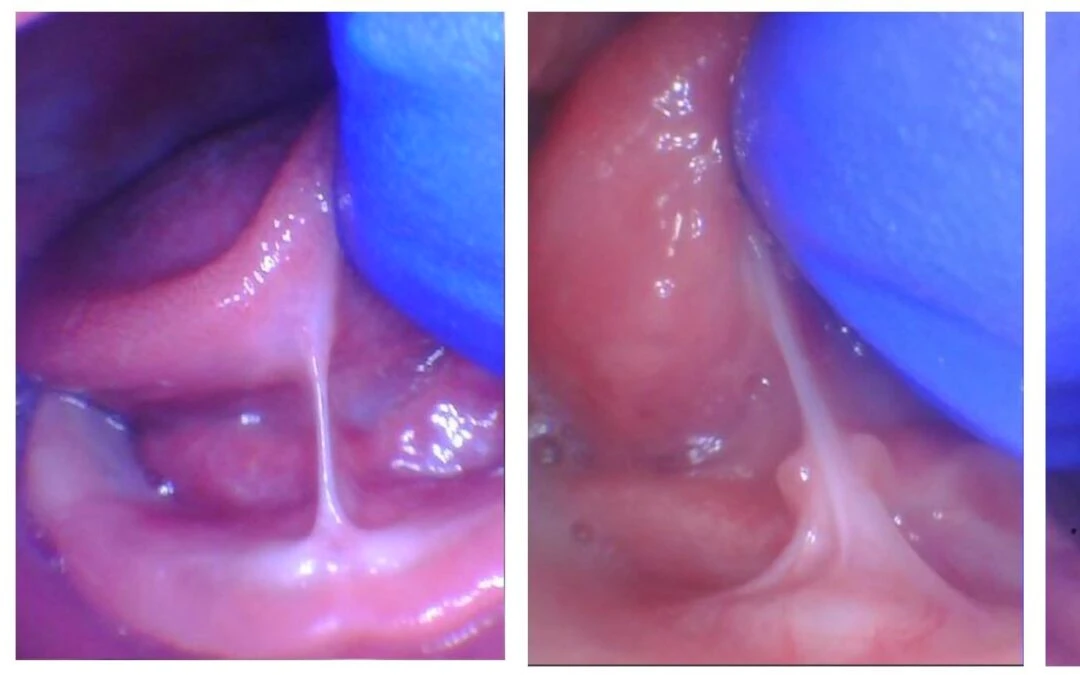
Most posterior tongue-ties are not actually “hidden.” They’re simply easy to overlook if we’re primarily evaluating appearance instead of function. If you simply lift the tongue with a tongue depressor or a finger cot, you won’t see much. You have to lift with both fingers, coming from behind, and challenge the tongue. Lift like a forklift.
Every baby has a frenulum. The presence of a frenulum doesn’t diagnose a tongue-tie any more than having a knee ligament means someone has a knee injury. The question isn’t whether tissue exists. The question is whether that tissue is limiting normal movement and contributing to meaningful symptoms.
Unfortunately, many healthcare providers receive very little formal education in infant oral function. That isn’t meant as criticism. It’s simply the reality of most medical and dental training programs. Tongue-ties may receive only brief attention, and posterior tongue-ties are often discussed even less (really not at all!). That’s why I wrote Tongue-Tied 8 years ago, and also why we created Tongue-Tied Academy to address this knowledge gap.
As a result, providers frequently rely on what they can immediately see.
Also Read: What I Wish Every Pediatrician Knew About Tongue-Ties
Why Function Matters More Than Appearance
The challenge is that posterior tongue-ties don’t always announce themselves with an obvious band extending to the tip of the tongue. Some are quite subtle visually while still creating significant functional limitations. Others appear restrictive but function surprisingly well.
That’s one of the reasons I rarely make treatment recommendations based on appearance alone. When I evaluate a baby, I want to understand the entire story. How has feeding been going? Is breastfeeding painful? Is the baby transferring milk efficiently from the breast or bottle? Can the tongue elevate appropriately? Can it extend? Can it maintain suction throughout the feeding? Does the history make sense when combined with the examination?
No single finding answers the question. It’s the combination of history, symptoms, examination, and function that guides my recommendation. Just because a baby is gaining weight does not mean there is nothing to do, and the restricted tongue is functioning well.
Listening to Parents Is Part of the Diagnosis
One thing I’ve learned after evaluating thousands of babies is that parents are often excellent observers.
They may not know what a posterior tongue-tie is, but they’ll tell me things like, “She keeps losing suction,” or “He clicks every time he nurses.” They’ll describe milk leaking from the corners of the baby’s mouth, prolonged feedings, excessive gas, or a baby who never seems satisfied despite nursing constantly.
Those observations matter. They’re not a diagnosis, but they often point me toward asking better questions during the examination. At the same time, I think it’s equally important to avoid assuming that every baby with feeding difficulties has a posterior tongue-tie. They don’t.
I’ve evaluated many babies whose feeding challenges were also related to body tension, prematurity, maternal milk supply, oral motor immaturity, neurologic conditions, or other factors. Some babies improve dramatically with lactation support, physical therapy, occupational therapy, or simple changes in positioning.
That’s why I don’t approach every evaluation looking for a frenectomy. I approach every evaluation trying to understand why this particular baby is struggling. Sometimes the answer is a tongue-tie. Sometimes it’s a lip or cheek tie. Sometimes it’s all three. But sometimes it isn’t.
Improve Your Clinical Assessment
Gain confidence evaluating posterior tongue-ties with Dr. Baxter’s evidence-based training.
Why I Created Tongue-Tied Academy
If you’re a dentist or physician who wants to become more confident evaluating posterior tongue-ties and understanding when treatment is and isn’t appropriate, that’s exactly why I created Tongue-Tied Academy. The course walks through my complete assessment process using dozens of real clinical cases so providers can develop confidence in their own decision-making rather than relying on appearance alone. It’s also an excellent right tongue tie certification course for clinicians who want structured, evidence-based training in functional assessment and treatment planning.
For speech-language pathologists, occupational therapists, pediatricians, physical therapists, IBCLCs, chiropractors, and other therapists who work with infants and children, Tongue-Tied Academy LITE focuses on the role each member of the multidisciplinary team plays before and after treatment.
Parents reading this article may be wondering whether any of this describes their own baby. If you’ve been told everything looks normal but feeding still doesn’t feel right, don’t ignore your instincts. A comprehensive functional evaluation can often provide answers, whether those answers involve a tongue-tie or something entirely different. If you’d like to discuss your baby’s feeding difficulties, you can send us a message to schedule an evaluation.
Read Also: What Is Included in a Tongue-Tie Training Course?
Why the Conversation Around Posterior Tongue-Ties Has Become So Polarized
One of the things that concerns me most is how polarized conversations about tongue-ties have become.
On one side are people who believe nearly every feeding difficulty is caused by a tongue-tie. On the other hand are those who believe posterior tongue-ties rarely (don’t) exist or almost never need treatment. Some providers say “I don’t believe in tongue-ties.” It’s not a religion!
In my opinion, neither position serves families well. The reality is much more nuanced.
Some babies have significant functional restrictions that dramatically affect feeding and respond beautifully to treatment. Others have a restrictive-appearing frenulum but feed efficiently and don’t need a procedure. Since they are not struggling, a lot of these families never come to our office because there is no perceived issue. There are also babies whose feeding difficulties are caused by multiple factors simultaneously. A tongue-tie may be one piece of the puzzle, but rarely is it the only piece.
Every Baby Deserves an Individualized Evaluation
That’s why I believe every recommendation should be individualized.
I never want a parent to feel like they were pressured into treatment simply because a frenulum was present. At the same time, I don’t want families to spend months searching for answers because a clinically significant tongue-tie was dismissed after a quick visual examination.
Finding the right balance requires experience, careful observation, and a willingness to slow down long enough to understand the whole picture. That’s why we always reserve plenty of time for our consultations and also save time for treatment if needed, since many of our patients travel from out of state.
Why a Multidisciplinary Approach Leads to Better Outcomes
One of the biggest lessons I’ve learned over the years is that feeding isn’t simply about the tongue. It’s a coordinated process involving the tongue, lips, jaw, palate, airway, muscles of the neck, neurologic development, maternal milk supply, positioning, and often several other factors that are unique to each baby.
That’s one of the reasons I value a multidisciplinary approach so highly.
Some of the best outcomes I’ve seen have come from collaborating with lactation consultants, speech-language pathologists, occupational therapists, physical therapists, pediatricians, ENTs, and chiropractors experienced with infant care. Each provider brings a different perspective, and together we’re often able to help families more effectively than any one provider working alone.
A laser frenectomy is sometimes an important part of treatment. It is rarely the entire treatment. Proper wound care after tongue-tie release and follow-up support also play an important role in helping babies heal and adapt to their improved tongue mobility.
Preparing families for realistic expectations is just as important as performing the procedure itself. Some babies improve immediately. Others improve gradually over several weeks as they learn to use a tongue that suddenly has much greater freedom of movement. Some benefit from bodywork before treatment. Others need additional feeding therapy afterward. Every baby writes a slightly different story.
Why I Enjoy Teaching Healthcare Providers
That’s another reason I enjoy teaching.
When I first began treating tongue-ties, there wasn’t a comprehensive educational resource that combined anatomy, functional assessment, laser technique, aftercare, and multidisciplinary care into one practical program. I spent years refining my own approach through experience, collaboration with other providers, and continual learning.
Eventually, I realized that if I had struggled to find practical education, many other providers probably had as well. That became the foundation for Tongue-Tied Academy.
The goal has never been to convince providers to perform more procedures. The goal is to help them make better clinical decisions. Sometimes that means recommending treatment. Sometimes it means recommending therapy first. Sometimes it means reassuring parents that a procedure isn’t necessary.
Confidence comes from understanding the evaluation process, not from memorizing a list of symptoms.
Education for Every Member of the Care Team
If you’re a dentist or physician who wants a practical, evidence-informed approach to tongue-tie assessment and treatment, I’d encourage you to explore Tongue-Tied Academy.The course is built around real patients, real examinations, and the clinical decision-making process I’ve developed over many years in practice.
If you’re an IBCLC, speech-language pathologist, occupational therapist, pediatrician, physical therapist, chiropractor, or another therapist who works with infants and children, Tongue-Tied Academy LITE was created specifically for your role on the treatment team.
If you’re a parent who found this article because your baby is struggling with feeding, remember that online articles can only provide general education. They can’t diagnose your child. If you’ve been searching for answers, or you’ve been told everything looks normal but feeding still isn’t going well, a comprehensive functional evaluation may provide the clarity you’ve been looking for. If you’d like to discuss your concerns, send us a message. I’d be honored to help determine whether a tongue-tie or another feeding issue is contributing to your baby’s symptoms. We welcome families to Alabama from across the USA and even around the world.
FAQ,s
Q1. Are posterior tongue-ties real?
Ans. Yes. Posterior tongue-ties are recognized by many experienced clinicians and many research studies. The challenge isn’t whether they exist, but how to evaluate them appropriately. Functional assessment is far more important than appearance alone.
Q2. Why are posterior tongue-ties frequently missed?
Ans. Many healthcare providers receive limited formal education in functional infant oral assessments. In addition, some posterior tongue-ties are visually subtle and require a careful examination of tongue mobility and feeding function.
Q3. Can a baby have a posterior tongue-tie and still feed well?
Ans. Absolutely. Not every posterior tongue-tie causes significant functional limitations. Treatment decisions should be based on symptoms and function rather than anatomy alone.
Q4. Should every posterior tongue-tie be released?
Ans. No. A frenectomy should only be recommended when the baby’s history, examination, functional limitations, and symptoms support that decision.
Q5. What is the most important part of a tongue-tie assessment?
Ans. In my opinion, understanding function is the key. A comprehensive evaluation considers feeding history, tongue mobility, oral function, and the entire clinical picture before treatment is recommended.
Continue Reading
You may also enjoy these articles:
I believe the conversation surrounding posterior tongue-ties is gradually moving in the right direction. We’re learning that thoughtful evaluation is more valuable than quick assumptions, and that careful functional assessment almost always leads to better decisions. My hope is that, as education continues to improve, fewer families will spend months wondering why feeding feels so difficult, and more providers will feel confident evaluating these babies with both curiosity and humility. Thanks for reading this far! – Dr. Baxter

Not Sure About a Posterior Tongue-Tie?